
Discounts can be a powerful way to attract customers and encourage them to complete a purchase. However, simply putting a “20% Off” banner across your WooCommerce store doesn’t necessarily increase customer spending.
In many cases, shoppers may purchase exactly what they were already planning to buy, which means you’re giving away part of your margin without increasing the order’s value.
The more effective approach is to use discounts with a specific goal in mind.
Instead of asking how much you should discount, think about what you want customers to do. Do you want them to add another product? Buy multiple quantities? Reach a higher cart value? Purchase a complementary product? Or come back for another order?
When discounts are connected to these behaviors, they can become more than just a way to lower prices. They can be a tool to increase your average order value.
In this article, we’ll explore seven practical WooCommerce discount strategies that can encourage customers to spend more while still giving them a compelling reason to purchase.
Why Should You Use Discounts to Increase Average Order Value?
Before creating a discount campaign, it is important to understand what you are actually trying to improve.
Average order value is the average amount a customer spends per order. You can calculate it by dividing your total revenue by the number of orders. For example, if your store makes $10,000 from 200 orders, your average order value is $50.
Now imagine that you can increase that number to $60 without having to acquire 200 additional customers. With the same 200 orders, your revenue would increase from $10,000 to $12,000.
That is why increasing AOV can be an effective way to grow a WooCommerce store. Instead of focusing entirely on getting more visitors, you can also find ways to make each existing order more valuable.
Discounts can help with this when they are designed around a specific purchasing behavior. A “20% off everything” promotion primarily reduces product prices. But an offer such as “Spend $100 and get $15 off” gives customers a reason to increase their cart value.
The difference may look small, but it completely changes the purpose of the promotion.
Rather than using discounts simply to make products cheaper, you are using them to encourage customers to buy more.
Best Practices for WooCommerce Discount Strategies
| Strategy | Advantage | Impact on AOV | Watch-outs |
| Spend threshold ($10 off at $75) | Gives a reason to add one more item | Strong when the first bar sits just above your current AOV | Set the number too low, and you give margin away on carts that would have checked out anyway |
| Buy X, Get Y / BOGO | Reward only after extra units or a second product | Raises items per order, especially on products people buy in sets | Weak if the free or cheap item has no real use with the first product |
| Quantity / tiered pricing | Better unit price as the quantity grows | Works on stock-up items (coffee, basics, consumables) | Hidden tiers get ignored. Show the table on the product page |
| Free shipping minimum | Feels like avoiding a fee, not “spending more” | Often lifts carts that sit just under the shipping bar | Must still cover shipping cost. A live “$12 away” message helps more than a static line |
| Complementary product discount | Sells the item that belongs with the first purchase | Grows cart value without stacking more of the same SKU | Pairings have to make sense. Random add-ons look like a push |
| Limited-time offer | Creates a real reason to decide now | Best stacked with a spend or quantity rule | Fake timers that restart train shoppers to wait. End the campaign when you say it ends |
| Next-order coupon | Brings the buyer back instead of padding this cart | Helps lifetime value more than today’s AOV | Large, always-on codes train people to never pay full price |
Use one strategy at a time, then check AOV, items per order, discount cost, and margin together. A bigger cart that wipes the profit is not a win.
Let’s take a look at each option below.
1. Offer Discounts When Customers Reach a Spending Threshold
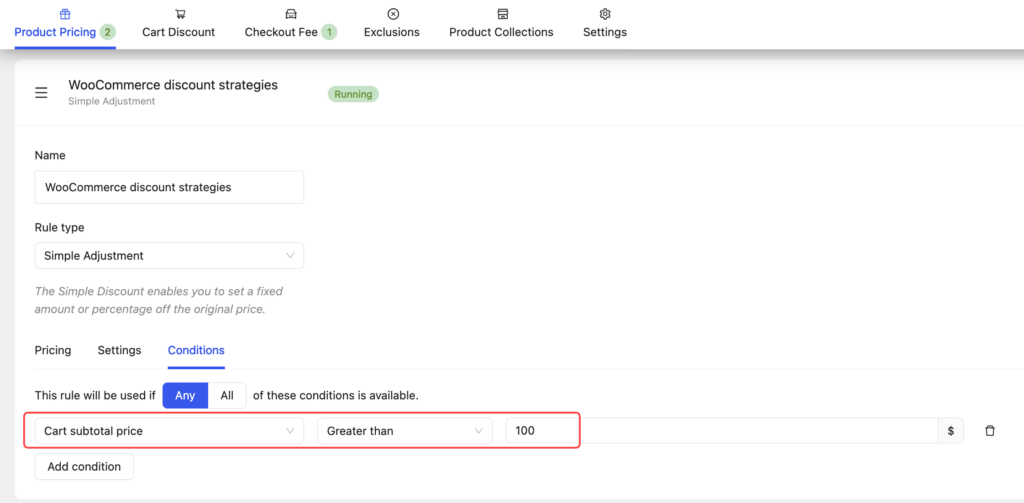
One of the simplest WooCommerce discount strategies for increasing AOV is to set a minimum spending threshold.
Instead of offering a discount to every customer, you give customers a reward when their cart reaches a specific amount. For example, you might offer $10 off when customers spend $75 or $20 off when they spend $100.
This changes the customer’s purchasing decision.
Imagine someone has already added $65 worth of products to their cart. If they see an offer saying “Spend $75 and save $10,” they may start looking around your store for another product worth $10 or more.
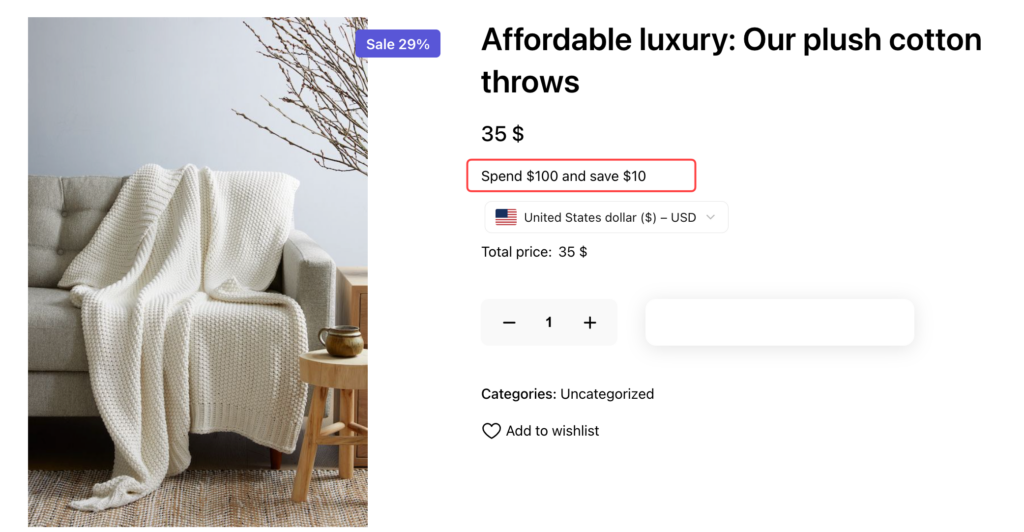
Without the promotion, they might have checked out at $65. With the promotion, they have a reason to increase their order.
You can also create multiple spending levels to encourage customers to keep adding products. For example, you could offer $5 off at $50, $10 off at $75, and $20 off at $100. This creates several opportunities for customers to reach the next reward.
The most important thing is to choose your thresholds carefully. Look at your current AOV and set the first threshold slightly above what customers typically spend. If your average order is $45, a $50 or $55 threshold may be a reasonable place to start testing.
There are several ways to implement this type of promotion in WooCommerce. You can use the built-in coupon system for simple offers, or use a dynamic pricing or discount plugin when you need more advanced rules and automatic discounts. With YayPricing, you can create conditional cart discounts and spending-based promotions without requiring custom code.
2. Try Buy X, Get Y Promotions
Another popular approach is the Buy X, Get Y discount.
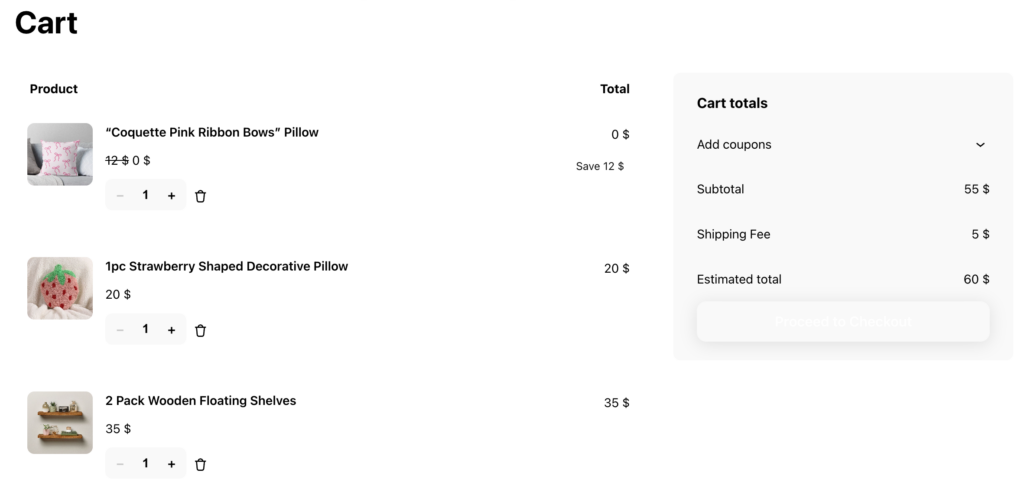
You’ve probably seen promotions such as “Buy 2, Get 1 Free” or “Buy 3, Get 1 at 50% Off.” These offers are effective because customers need to purchase additional products before they receive the reward.
For example, imagine a customer visits your store intending to purchase two T-shirts. If your promotion says “Buy 2, Get 1 Free,” the customer now has a reason to add a third T-shirt to their cart.
The customer receives more value, while your store increases the number of items sold in the order.
This strategy works particularly well for products that customers naturally purchase in multiples, such as clothing, cosmetics, snacks, stationery, accessories, and other consumable products.
You don’t necessarily have to give away the same product, either. You could use a complementary-product promotion instead. For example, customers who buy a laptop could receive a laptop bag at 50% off, or someone buying a camera could get a memory card at a reduced price.
The important thing is to make the additional purchase relevant. A good Buy X, Get Y promotion should make customers think, “I’m getting something useful for a better price,” rather than “The store is trying to make me buy something I don’t need.”
WooCommerce store owners can create these promotions using coupon extensions, dynamic pricing plugins, or custom solutions. Let’s see how YayPricing supports BOGO and Buy X, Get Y rules, allowing store owners to automatically apply discounts when customers meet specific purchase conditions.
3. Use Quantity Discounts to Encourage Larger Purchases
What if your customers already want to purchase a particular product, but you want them to buy more units?
In this case, quantity-based discounts can be a great option. The idea is simple: customers receive a better price when they purchase a larger quantity.
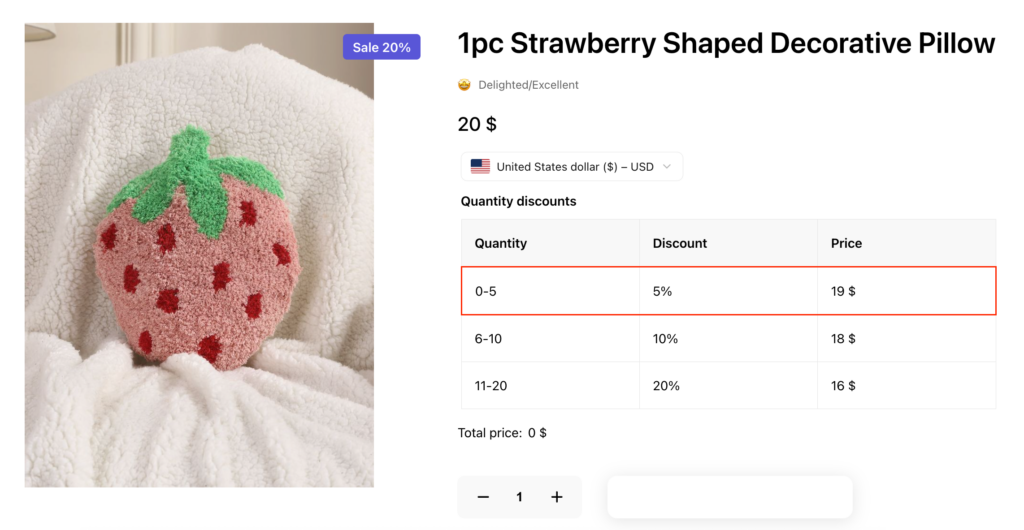
For example, you might sell a product for $20 when purchased individually, but offer a lower unit price when customers buy three or five:
- 1 item: $20 each
- 3 items: $18 each
- 5 items: $16 each
Now customers have a reason to increase their quantity.
This approach works particularly well for products that people tend to stock up on – coffee, food, beauty products, office supplies, clothing basics, and other frequently used items.
However, simply having quantity discounts isn’t enough. Customers need to understand how pricing works before making their purchase decision. A pricing table on the product page can make a big difference. Instead of hiding the discount somewhere in your terms and conditions, show customers exactly how much they can save by purchasing more.
Using YayPricing to create a tiered rule can display the pricing table directly on the product page. The goal isn’t to convince every customer to buy five units. It’s to make buying a larger quantity attractive to customers who already have a reason to do so.
4. Set a Free Shipping Threshold
Discounts aren’t the only way to encourage customers to increase their order value. Free shipping can work just as well.
Instead of offering free shipping on every order, set a minimum amount customers need to spend to qualify – for example, free shipping on orders over $75.
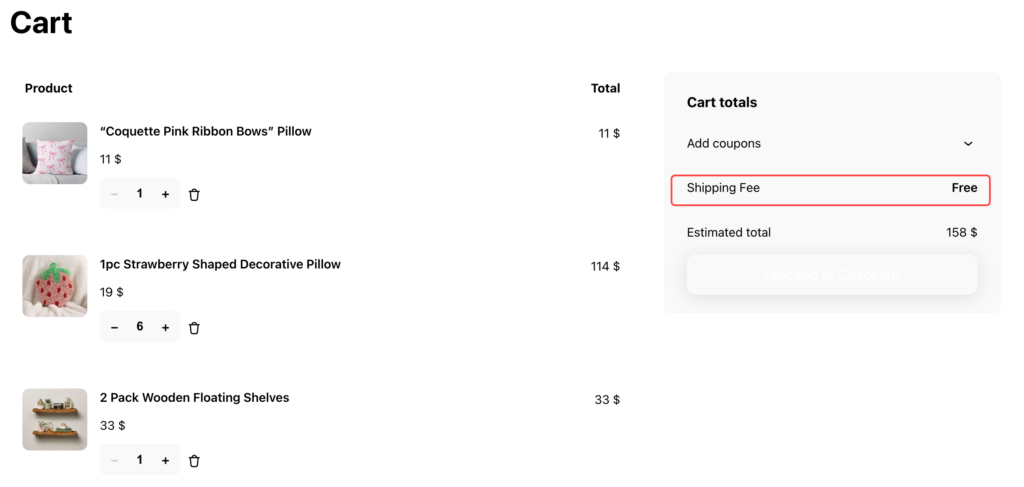
Now consider a customer whose cart is worth $63. If shipping costs $8, they might decide to pay the fee and check out. But if they see that they’re only $12 away from free shipping, they may decide to add another product instead.
This is why free-shipping thresholds can be such a useful AOV strategy. Customers don’t necessarily feel like they’re spending more; they feel like they’re avoiding an additional cost.
The threshold should be based on your own store’s numbers. If your AOV is currently $50, you might test free shipping at $60 or $65, while making sure the threshold is high enough to protect your margins after accounting for shipping costs.
It’s also important to communicate the threshold clearly. A static message like “Free shipping over $75” works, but a dynamic message is often more effective: “You’re only $12 away from free shipping!”, it tells customers exactly what to do next.
WooCommerce’s shipping settings let you configure the threshold itself, but showing customers real-time progress toward it usually takes a separate cart notice or bar. This is a fairly specific feature, and a few sales-boosting plugins offer it, YayBoost, for instance, includes a progress-style free shipping bar for this purpose.
Whatever tool you use, the strategy is the same: free shipping creates a reason for customers to increase their cart value, and the plugin just makes the incentive easier to communicate.
5. Discount Complementary Products
Sometimes the best way to increase AOV isn’t to sell more of the same product; it’s to help customers discover another product that naturally belongs with what they’re already buying.
Think about how people shop in the real world. Someone buying a camera may need a memory card. Someone buying a laptop may need a mouse or laptop bag. Someone buying a shirt may want matching trousers or accessories.
These are complementary products, and they can create excellent opportunities for targeted discounts, such as: “Buy this camera and get 15% off a memory card.”
This type of promotion can feel much more relevant than a storewide discount because the customer can immediately understand why the additional product is useful. You can also combine product recommendations with bundle discounts, for example, presenting a camera, memory card, and camera bag together with a small discount for buying all three.
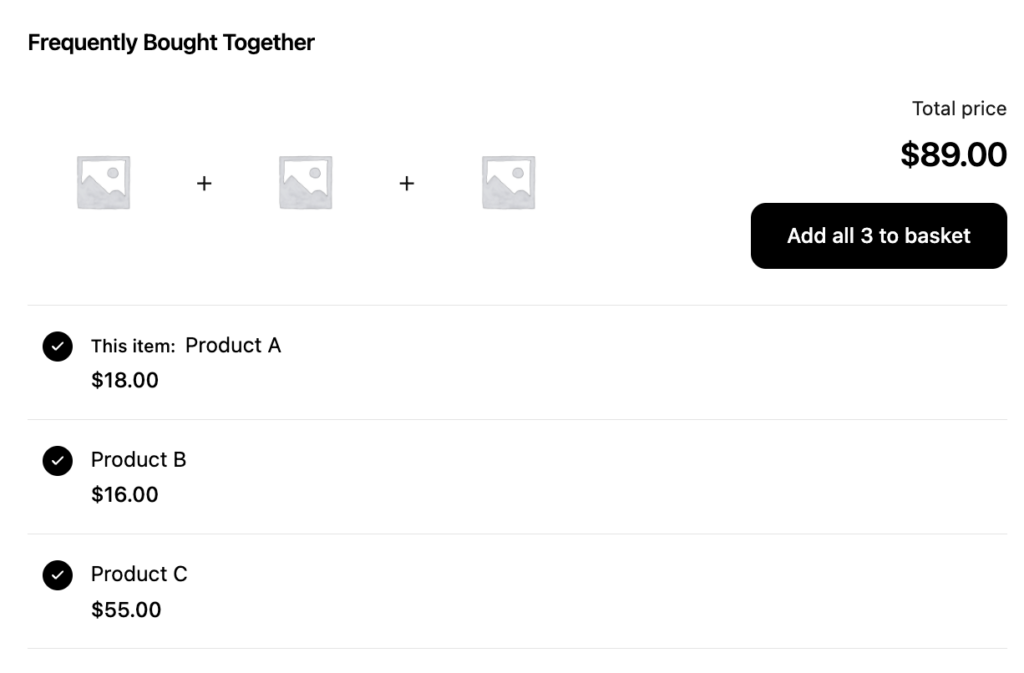
There are several ways to create these offers in WooCommerce: manually building product bundles, using related-product recommendation plugins, setting up conditional coupon rules, or using a tool that combines recommendations with pricing logic. If you have a large catalog, a plugin that surfaces frequently bought together combinations from your own order history can save a lot of manual guesswork compared to picking pairings by hand.
6. Create Limited-Time Discounts
Sometimes customers don’t need a bigger discount. They simply need a reason to make a decision now.
That’s where limited-time promotions can help. A promotion such as “Spend $100 and save $20, this weekend only” creates a sense of urgency that a permanent discount doesn’t have.
This can be particularly useful for seasonal campaigns, product launches, holiday sales, clearance campaigns, and major shopping events. You can also combine urgency with other discount strategies, such as “Buy 2, Get 1 Free – Ends Sunday” or “Spend $100 and get $20 off – 8 hours left.”
However, make sure your deadlines are genuine. If a countdown timer reaches zero and the exact same promotion immediately starts again, customers may stop trusting your urgency messages.
You can schedule these promotions using WooCommerce’s coupon expiration dates for simple cases, or a marketing calendar tool or pricing plugin with built-in scheduling when you’re running several timed campaigns at once.
YayPricing provides campaign scheduling and countdown functionality, making these promotions easier to manage from WordPress. The important part is not the countdown itself. The real strategy is giving customers a clear and legitimate reason to act before the offer disappears.
7. Reward Customers for Their Next Purchase
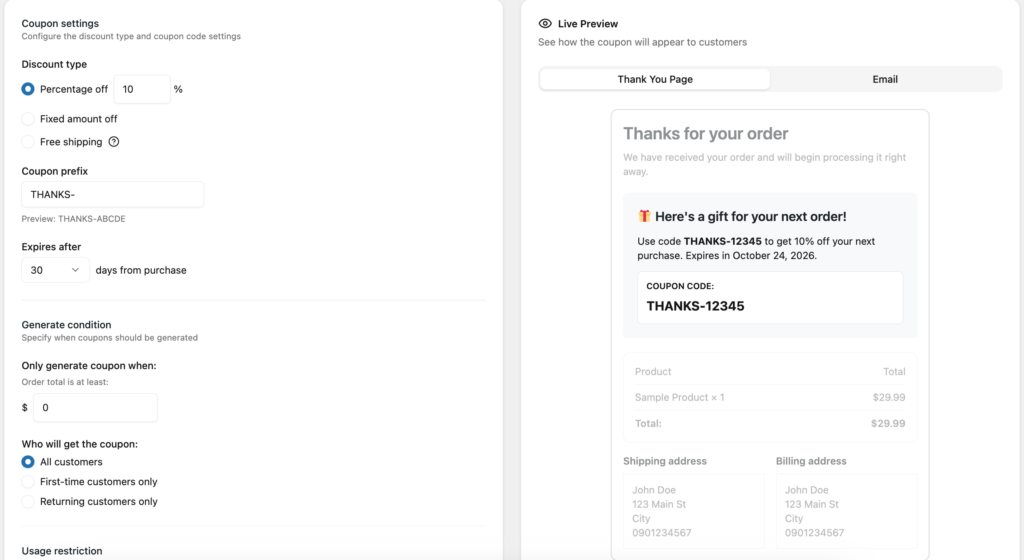
Discounts can also be used after the current order is completed. Instead of trying to increase the value of today’s order, you give customers a reason to come back and place another order, for example, “Thanks for your purchase! Get 15% off your next order.”
This strategy can work particularly well for stores that sell products customers purchase repeatedly: fashion, beauty, food, pet products, accessories, and other consumables. If customers are likely to need your products again, a next-order incentive can help turn a one-time buyer into a returning customer.
The important thing is to avoid training customers to wait for discounts. You don’t need to offer a huge discount every time; a small, time-limited incentive can be enough to create another reason to return.
Most stores implement this through email marketing automation (a post-purchase email with a coupon code) or a dedicated post-purchase plugin that generates and sends the coupon automatically.
You can implement this strategy using WooCommerce coupon functionality, email marketing automation, or a sales-boosting plugin. YayBoost, for example, includes a Next Order Coupon feature that can automatically provide customers with an incentive for their next purchase.
This strategy is slightly different from the others in this article because the goal isn’t necessarily to increase today’s AOV. Instead, it can increase the customer’s lifetime value, which is another important part of sustainable ecommerce growth.
Make Your Discounts Work With Your Store, Not Against It
One of the biggest mistakes WooCommerce store owners can make is assuming that more discounts automatically mean more sales. They don’t.
If customers know that your store is always offering 20% off, they may simply wait for the next promotion before buying, while you reduce your margin on customers who would have purchased at full price anyway.
That’s why your discount strategy should always have a clear purpose. Before launching a promotion, ask yourself: what customer behavior do I want to encourage?
- To buy more units → quantity discounts
- To add complementary products → bundles
- To increase cart value → a spending threshold
- To reduce shipping-related hesitation → a free shipping threshold
- To complete a purchase sooner → a genuine limited-time promotion
- To return → a next-order incentive
This approach helps you move away from random discounts and toward promotions that support a specific business goal.
Track Your Results
After launching a discount campaign, don’t judge its success solely by the number of orders. A promotion may generate more orders while actually reducing your overall profitability.
Instead, look at several metrics together: average order value, conversion rate, revenue, number of items per order, discount amount, profit margin, and repeat purchase rate.
For example, suppose your AOV increases from $50 to $65 after introducing a $10 discount for orders over $60. That sounds positive, but you should also check whether the additional revenue from larger carts is enough to compensate for the discount you’re giving. You can then experiment with different thresholds and incentives to find the balance between customer value and profitability.
Think of every promotion as a test. You don’t have to get it perfect the first time.
Frequently Asked Questions
Now, let’s take a look at some frequently asked questions about this topic.
What are the best WooCommerce discount strategies for increasing AOV?
There is no single offer that lifts every store. Spending thresholds, Buy X Get Y, quantity pricing, free-shipping minimums, complementary-product discounts, timed campaigns, and next-order coupons all work when they match how people already shop. A storewide 20% off rarely raises average order value. It usually cuts the price of the cart they were going to buy anyway.
How can I increase average order value in WooCommerce?
Give shoppers a reason to add something extra. Raise the cart with a spend-and-save rule, a quantity break, a related-item discount, or free shipping at a number just above your current AOV. Product recommendations and bundles help even when the discount is small. Start with one rule, measure AOV and margin together, then add the next offer.
How do I create a minimum-spend discount in WooCommerce?
WooCommerce coupons can handle a simple “$10 off when the cart is $75.” Automatic cart discounts, several spend tiers, and live messages usually need a dynamic pricing plugin. YayPricing can apply a conditional cart discount when the total crosses each threshold, so the shopper does not have to remember a code.
Can discounts reduce my profit?
Yes. More orders at a weaker margin can leave you with less money. Check AOV, items per order, discount cost, conversion rate, and profit together. If AOV rises from $50 to $65 only because you gave $10 away at $60, run the numbers before you keep the rule live.
How does a Buy X, Get Y promotion raise order value?
The reward only appears after the customer adds extra units or a second product. “Buy 2, get 1 free” or “buy a camera, get 50% off a memory card” changes the cart size. YayPricing can run BOGO and Buy X Get Y rules automatically once the condition is met, which is cleaner than handing out a code on every order.
Do quantity discounts work if customers already want one item?
They work when people stock up: coffee, basics, beauty, office supplies. Show the break on the product page (1 at $20, 3 at $18, 5 at $16) so the better unit price is obvious before they add to cart. A YayPricing tiered rule can put that table on the product page instead of hiding it in the fine print.
Is a free shipping threshold a discount strategy?
It acts like one. Shoppers often add a small item to avoid the shipping fee. Set the bar a little above your current AOV and show how much is left. WooCommerce can set the threshold. A cart bar (YayBoost has one) makes the next step obvious. Keep the number high enough that free shipping still leaves a margin.
How should I run a limited-time WooCommerce discount?
Pair a real end date with a spend or quantity rule, not a fake timer that restarts. Coupon expiry works for one code. Running several campaigns at once is easier with a pricing plugin that can schedule rules. YayPricing includes campaign scheduling and countdown tools so the offer actually stops when you say it stops.
When do I need YayPricing instead of WooCommerce coupons?
Use coupons for a one-off code, a next-order email, or a simple minimum spend. Use YayPricing when the discount should apply itself: cart thresholds, BOGO, quantity tables, complementary-product rules, and timed campaigns. Pick the tool from the strategy. Do not install a plugin and then hunt for a rule to justify it.
Should every promotion try to raise today’s AOV?
No. A next-order coupon grows repeat purchases, not this cart. That still helps the store if you sell products people buy again. Keep that incentive small and time-limited so customers do not wait for a sale on every visit. Use WooCommerce coupons plus email, or a post-purchase feature such as YayBoost’s next-order coupon, and keep today’s AOV rules separate.
Final Thoughts
The best WooCommerce discount strategies aren’t necessarily the ones offering the biggest discounts.
They’re the ones that give customers a compelling reason to change what they were already planning to buy.
Instead of simply saying “20% off,” think about how you can encourage customers to add another product, purchase multiple units, reach a higher cart value, unlock free shipping, or return for another order.
Start with one strategy that fits your store, set a clear goal, and measure what happens. Once you understand how your customers respond, you can experiment with other approaches and gradually build a discount strategy that increases both sales and average order value.
And when you need more control than WooCommerce’s basic coupon system provides, there are plenty of tools available to help. Dynamic pricing plugins such as YayPricing, sales-boosting solutions such as YayBoost, product-bundling tools, email automation platforms, and other WooCommerce extensions can all help turn these ideas into real campaigns.
The important thing is to choose the tool based on the strategy – not the other way around.
Because a successful WooCommerce promotion isn’t about giving customers a discount; it’s about giving customers a reason to buy more.
Do you know any other methods we can use to increase the average order value? Let us know in the comments.
